In her evocative new exhibition curated by Lisa Henry, Dueling Gestures in the Archives, Houston-based artist Keliy Anderson-Staley takes viewers on a contemplative journey through memory, identity, and the fragile nature of archival preservation. On view at the Riverside Art Museum in California through January 12, 2025, the exhibition examines the ways personal histories are shaped, recorded, and reinterpreted through photographic and mixed-media works.
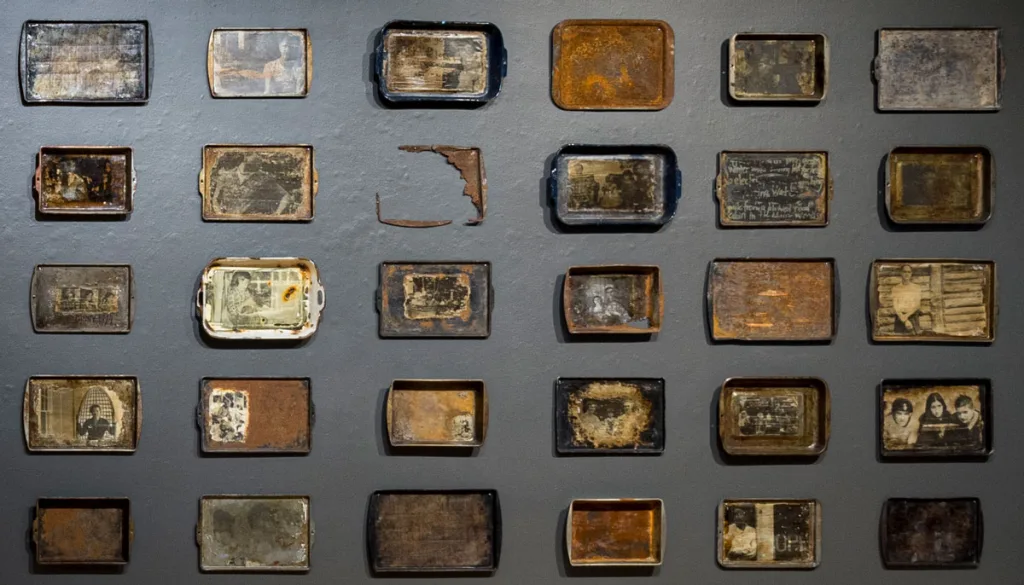
A standout piece is Anderson-Staley’s An Incomplete Family: Baking Pan Series (2000), a striking installation featuring 30 photographs of her family and younger self, printed on found baking pans using liquid emulsion. These images, embedded in the textured surfaces of everyday kitchen objects, evoke a sense of domesticity and history. The photographs, softened by time and the imperfections of the pans, resemble cherished family photos—faded and imperfectly preserved. By using baking pans, Anderson-Staley grounds her exploration of memory in the familiar and mundane, transforming utilitarian items into poignant vessels for storytelling.
In this installation, Anderson-Staley reflects on the fractures and incomplete narratives that often accompany family histories. The imperfections in the emulsion and uneven surfaces of the pans mirror the imperfections of memory, suggesting that what we preserve is as important as what we lose over time. The work captures the tension between personal memory and material form, with the medium itself playing an active role in the narrative.
Throughout Dueling Gestures in the Archives, Anderson-Staley employs 19th-century photographic processes—cyanotypes, tintype and silver gelatin photography—blending them with contemporary themes. This juxtaposition of traditional techniques with modern reflections on the past adds depth to her exploration of how we relate to history through both tangible artifacts and elusive recollections. Her innovative approach to archival materials reveals how process and method become integral to storytelling.
The exhibition’s title, Dueling Gestures, aptly captures Anderson-Staley’s exploration of conflicting narratives within family dynamics and the broader challenge of reconciling personal identity with inherited memory. Her investigation into her own family’s archive—a collection of photographs, letters, and objects—serves as both an intimate portrait of her upbringing and a broader commentary on how history is shaped by those who hold its records.
Personal history plays a significant role in Anderson-Staley’s work. Raised off the grid in Maine, she was shaped by an unconventional childhood and a profound discovery: the man who raised her was not her biological father. This revelation informs much of her work, especially in how she navigates the tension between what is known and what remains unknown in family narratives.
Her cyanotypes further explore the ephemeral nature of memory and materials. These delicate blue images, created from natural objects found at the site of her family’s former cabin, evoke a haunting sense of place and history. By exposing light-sensitive paper to the sun, Anderson-Staley captures fleeting moments, suggesting that even the most solid structures—like a home—can vanish, leaving behind only traces.
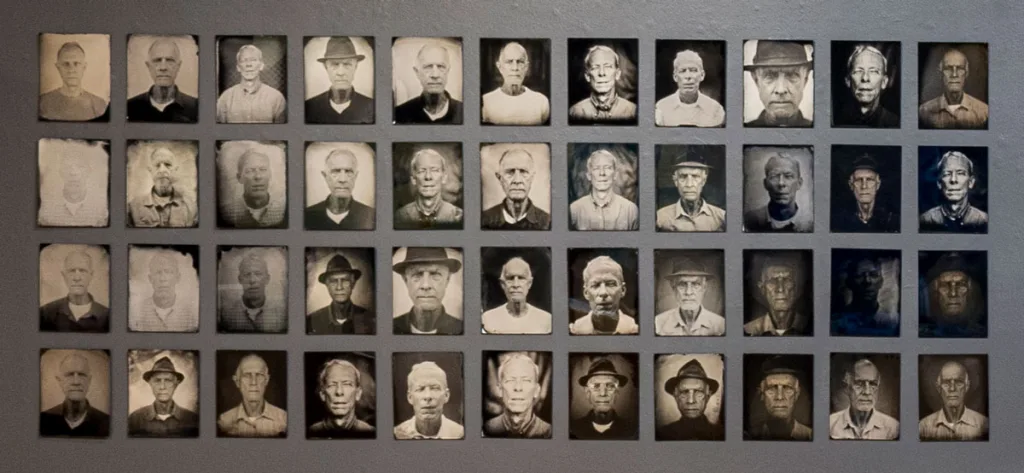
Another compelling piece in the exhibition is Father, Dad: Bill, Tom (Grid of 44), which addresses Anderson-Staley’s exploration of identity and familial bonds. This series of wet-plate collodion tintypes features 44 portraits of the two key men in her life: Tom, the man who raised her, and Bill, her biological father. Presented as an intermixed grid, the portraits blur the lines between the two men, making it difficult for viewers to distinguish between them.
This piece is particularly striking in how it plays with perception and the limitations of photographic representation. The portraits vary in clarity, with some sharp and revealing, while others are obscured by the imperfections of the tintype process. This instability mirrors Anderson-Staley’s own journey of understanding her identity and relationship with these two father figures. Despite their differences, the men appear uncannily similar in the photographs, raising questions about nature, nurture, and how personal histories are constructed.
None of the individual portraits offer a definitive representation of either man. Instead, the piece as a whole emphasizes the layered and fragmented nature of identity, much like memory itself. Anderson-Staley uses the imperfections of the wet-plate collodion process to symbolize the incomplete and often imperfect nature of family narratives.
Father, Dad: Bill, Tom (Grid of 44) challenges viewers to reconsider the reliability of photographs as records and to reflect on how we come to know and define those closest to us, especially when the lines between memory and reality blur.
As a whole, Dueling Gestures in the Archives presents a multifaceted and deeply personal look at how we process, store, and retrieve memories. Anderson-Staley’s blend of traditional photographic techniques with unconventional media encourages viewers to reflect on their own connections to family and history. The exhibition powerfully reminds us that our pasts are often as elusive and fragmented as the materials we use to remember them.
Keliy Anderson-Staley: Dueling Gestures in the Archive
August 31, 2024 – January 12, 2025
Riverside Art Museum • Members Gallery
3425 Mission Ave., Riverside, CA 92501
(951) 684-7111 • www.riversideartmuseum.org
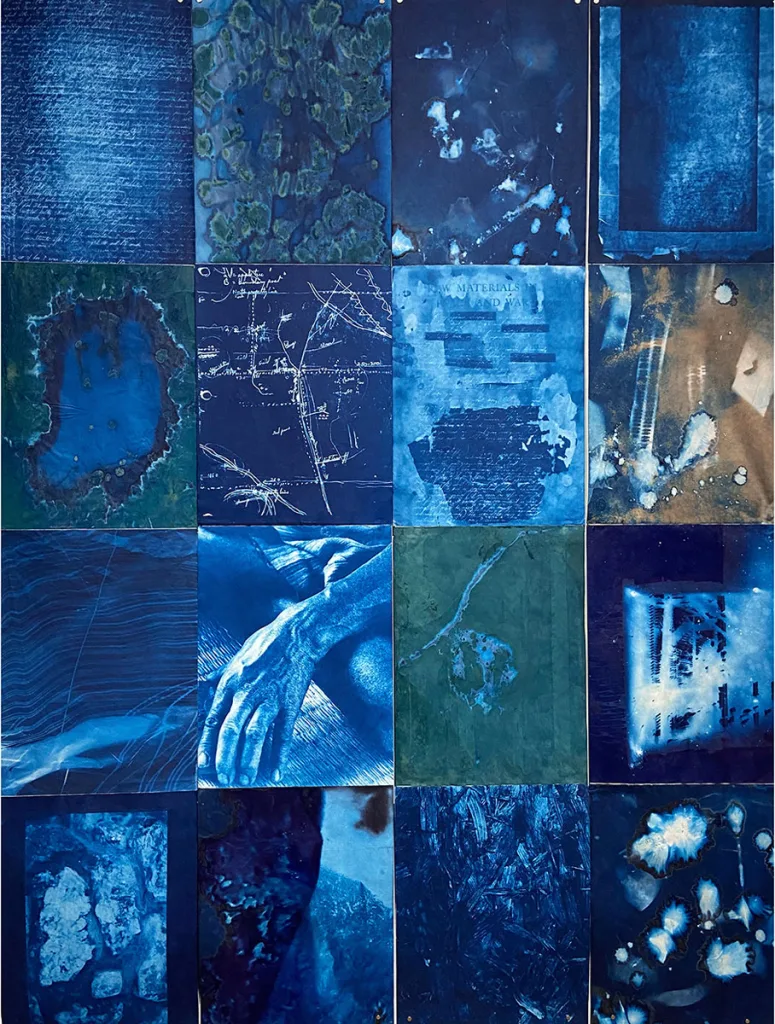
Keliy Anderson-Staley, Origin Stories on White with Hand Gesture, 2022
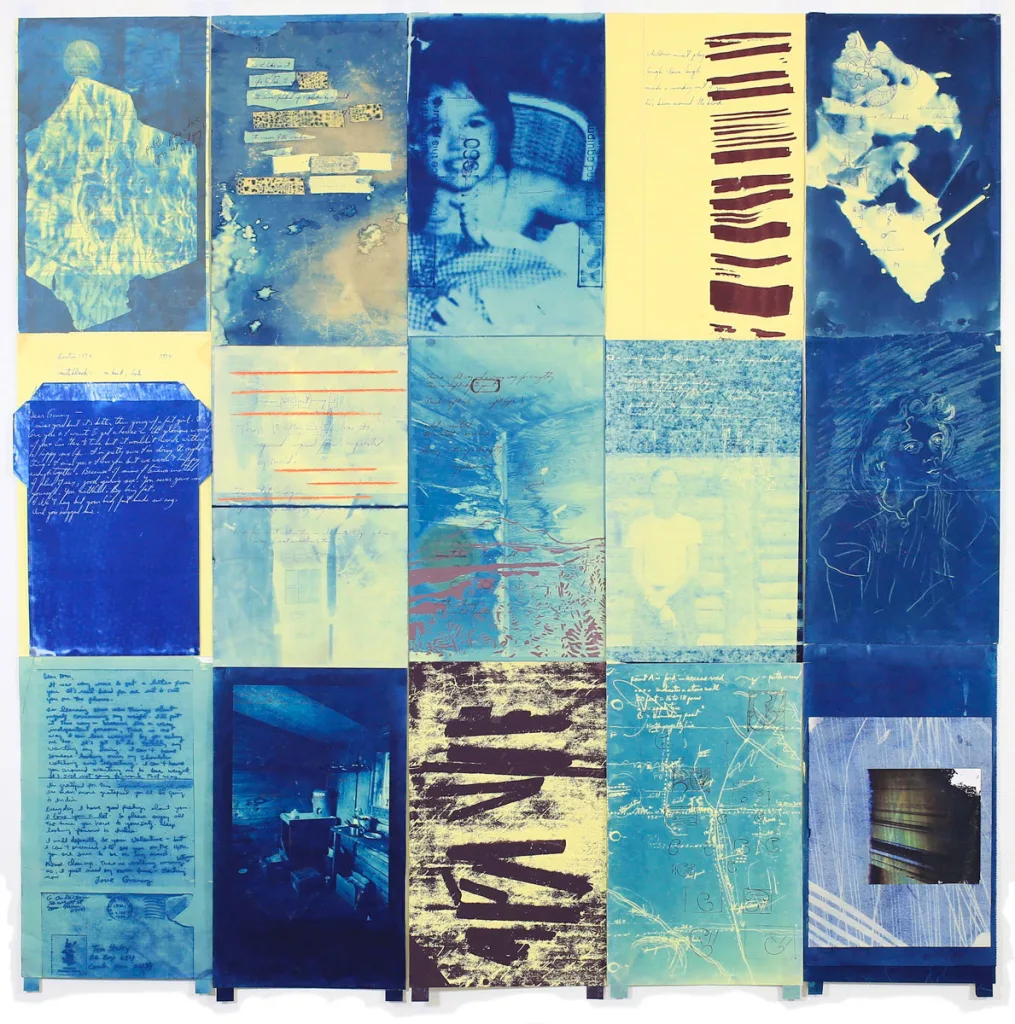
Keliy Anderson-Staley, Origin Stories with Yellow Piano, 2021